How to Organize Tupperware and Food Containers for Good
Last updated: 2026-08-14 · 5 min read

You open the cabinet to grab a container. A lid falls out, hits the counter, bounces to the floor, and now you're on your knees fishing a rogue piece of plastic out from under the fridge. Every. Single. Time. If that sounds familiar, you do not have a storage problem. You have a system problem. The good news is this is one of the most satisfying cabinets to fix, and once it's done right, it stays done. Here's exactly how to get there.
Start With a Full Purge
Pull everything out. Every container, every lid, every mystery piece of plastic you've been keeping "just in case." Lay it all on the counter or kitchen table where you can see it.
Now match lids to bases. If a lid has no match, it goes. If a base has no lid, it goes. No exceptions, no sentimental attachment to a container that used to have a lid. This step alone will cut your collection by a third, and that's not a problem -- that's the fix.
Also toss anything that's warped, stained beyond saving, or has cracks. Cracked plastic harbors bacteria and doesn't seal properly anyway. You're not being wasteful. You're being honest.
Decide How Many Containers You Actually Need
Most households need far fewer containers than they own. A practical set covers: two or three small containers (single-serving leftovers, cut fruit), three or four medium ones (half a batch of soup, meal prep portions), and two large ones (full casseroles, big batches). That's roughly ten to twelve pieces total, lids included.
If you meal prep heavily, you might want a dedicated set of uniform containers in one size. Uniform shapes stack flat, don't tip, and make lids completely interchangeable. Airtight Food Storage Containers (24-Pack) fits this perfectly -- 24 airtight pieces in consistent sizes that actually nest without drama.
Once you know your number, commit to it. One in, one out from here on.
Choose Your Storage Method
There are two approaches that work, and which one you pick depends on your cabinet space.
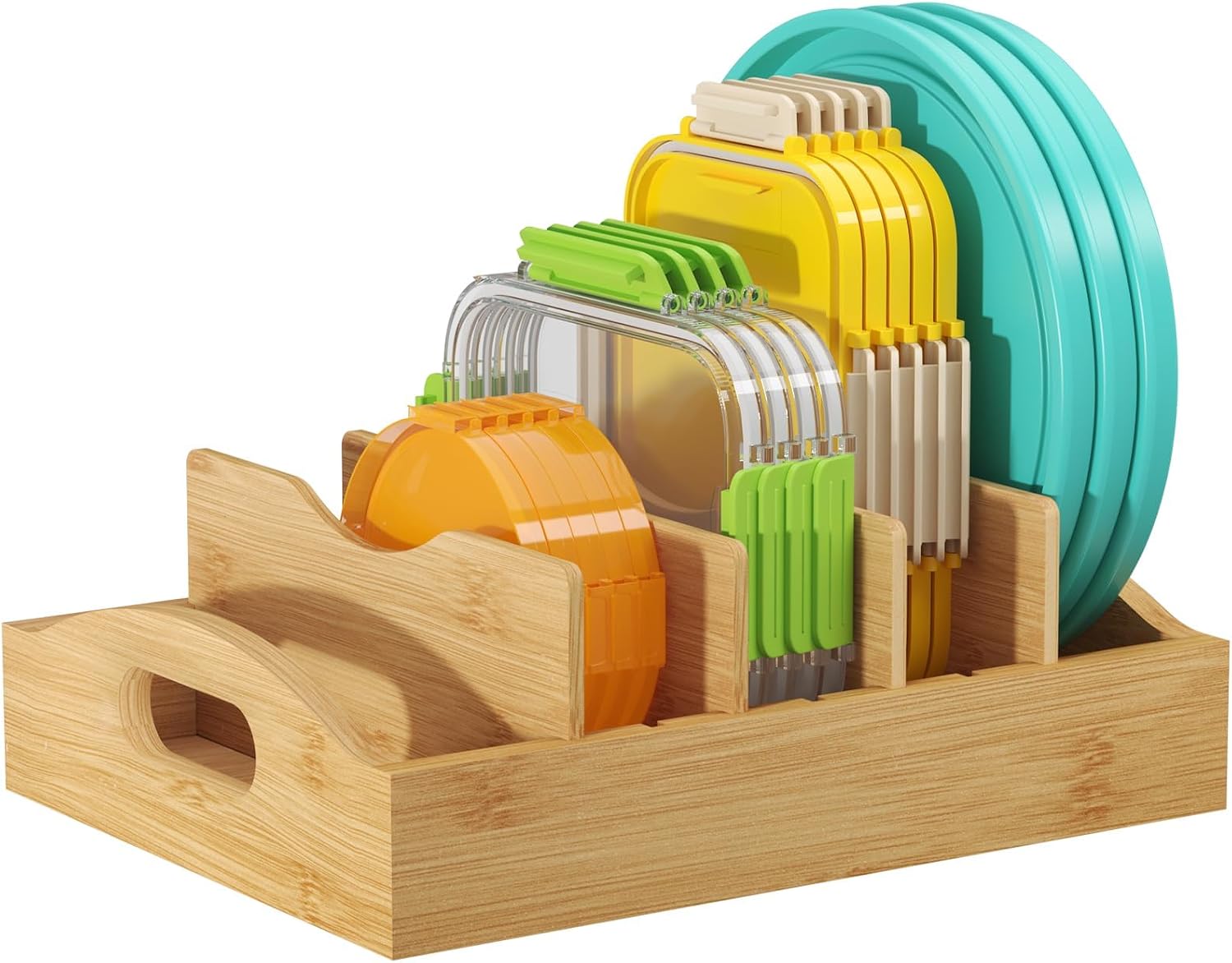
Option one: containers nested by size, lids stored separately in a dedicated organizer. This is the method I use, and it is, objectively, the most efficient use of vertical space. A bamboo lid organizer keeps lids upright and sorted so you can pull the right one without digging. Bamboo Food Container Lid Organizer does exactly this -- it holds lids vertically by size and sits neatly inside a drawer or on a shelf.
Option two: containers stored with their lids on. This takes more space but works well for families where multiple people are grabbing containers and nobody wants to learn the lid-filing system. (My fiance lobbied hard for this option. We compromised: lids-on for the large containers, separate organizer for everything else.)
Either way, keep the system visible and accessible. If someone has to think too hard to put something back, they won't.
Set Up the Cabinet or Drawer
Measure your space before you buy anything. Seriously -- pull out a tape measure. Note the depth, width, and height of the shelf or drawer you're dedicating to containers.
For a cabinet: use the lower shelf for stacked containers and the upper shelf (or back of the door) for lids. A drawer divider set can section a deep drawer into zones so containers don't slide around. Bamboo Kitchen Drawer Dividers (4-Pack) bamboo drawer dividers are adjustable and hold their position without any tools or adhesive.
For a deep drawer: stand containers on their sides by size, like files. Lids go in a section at the front or back. This is especially good for flat-bottomed rectangular containers that stack awkwardly upright.
Leave a little breathing room in the layout. A cabinet that is 80% full is a cabinet that stays organized. One that's crammed to the edge is one dropped lid away from chaos.
Label and Zone If You Have Multiple Container Types
If you have both everyday leftover containers and specialty ones (think: freezer containers, meal-prep sets, or lunch-box specific pieces), keep them in separate zones. Mixing them creates the same avalanche problem you started with.
A small label on the shelf edge -- or even just a strip of painter's tape with a handwritten note -- tells everyone in the household where things live. Yes, I label the shelves. No, I am not going to stop.
If you use a drawer, Bamboo Expandable Drawer Organizer is a bamboo expandable organizer that lets you create custom sections for different container types without any permanent changes to the drawer.
Build a Lid-Matching Habit
The system only works if lids and containers stay together in the right place. The biggest threat to any container cabinet is one person putting a lid in the wrong spot -- not out of malice, just out of haste.
Make it easier than getting it wrong. Store lids directly next to or above their matching containers. Use a vertical lid organizer sorted by size (small, medium, large) so there's always a clear place to return each piece. When you're unloading the dishwasher, match and return in one step rather than dumping everything in a pile to deal with later.
If you find the system slipping after a few weeks, it usually means one of two things: you have too many containers, or the return step has too many steps. Simplify whichever one is causing the friction.
Keep the Collection From Growing Back
The container cabinet is a magnet for accumulation. Takeout containers, random lids from sets you no longer own, and "I'll just keep this one" strays will creep back in without a rule to stop them.
Set a hard cap: pick a number and stick to it. When a new container comes in (a set you bought, a dish you got at a party), one old one leaves. Store only what fits in the designated space with the door closing easily. If it doesn't close easily, something goes.
If you want to upgrade your collection to something more uniform and airtight, do a full swap rather than mixing new pieces in with old ones. A complete set like Airtight Food Storage Containers (24-Pack) makes it easy to start fresh with matching lids and consistent sizing, which is the foundation the whole system rests on.
The takeaway: A well-organized container cabinet comes down to three things: fewer pieces, a consistent return system, and dedicated spots for lids. Get the number right, pick the storage method that fits your space and your household, and build the habit of putting things back in one step. Once the system is set up, maintaining it takes almost no effort -- which is exactly the point.