Kitchen Drawer Organizer Ideas for Deep and Awkward Drawers
Last updated: 2026-08-31 · 5 min read
Every kitchen has at least one. The drawer that swallows things whole. You open it looking for the vegetable peeler and come out the other side holding a mystery key, three rubber bands, and a birthday candle. Deep drawers, wide drawers, shallow-but-too-long drawers — they all share the same problem: standard organizers were not designed for them, and the stuff inside shifts every single time you close it. The good news is that awkward drawers are not a lost cause. They just need a slightly different approach than your average utensil drawer. Here is how to actually fix them.
Start by Measuring Everything (Yes, Everything)
Before you buy a single insert, measure your drawer. Width, depth from front to back, and height of the interior walls. Write it down. This sounds obvious but most people skip it, buy something that looks right online, and end up returning it.
Also measure your most-used items. A long spatula, a ladle, a set of tongs. If anything is longer than 12 inches, that changes your layout options significantly. Deep drawers (front to back) often fit items that tall drawers cannot, so treat that depth as an asset, not a problem.
The Two-Zone Rule for Deep Drawers
Deep drawers — the kind that go 20 or 24 inches back — work best when you divide them into two distinct zones: a front zone for things you grab daily and a back zone for items you use occasionally.
The mistake most people make is dumping everything in together. The front zone should be fixed and organized with a firm divider or insert. The back zone can hold larger, less-used tools standing upright or laid flat in a secondary container. Think of the back zone like a staging area, not a junk pile. Bamboo Expandable Drawer Organizer works well here because it expands to fit a range of drawer widths and lets you set the front zone firmly while the back stays flexible.
Expandable Dividers Are Your Best Friend for Odd Widths
If your drawer is an unusual width — say, 14 inches, or 22 inches — you are going to struggle with rigid plastic organizers that come in fixed sizes. Expandable bamboo dividers solve this cleanly. They press against the walls of the drawer with light tension, so they stay put without any adhesive or hardware.
Bamboo Kitchen Drawer Dividers (4-Pack) is what I use in two of our kitchen drawers. You can configure them vertically, horizontally, or in a grid depending on what you are storing. They also look considerably better than a jumble of plastic bins, which matters when my fiance is the one who has strong feelings about the kitchen aesthetic.
For Silverware and Utensils, Go Modular
The classic silverware tray works fine for a standard drawer but falls apart the moment your drawer is wider or deeper than average. A modular system lets you build a layout that fits your actual space instead of forcing your stuff into someone else's idea of a kitchen drawer.
For utensils in a wider drawer, a 5-slot organizer gives you room to separate cooking tools by category without cramming them. Utensil Drawer Organizer (5-Slot) fits neatly alongside a silverware section without wasted space. If your drawer is wide enough for both flatware and cooking tools, pair it with a 9-slot silverware tray on the other half. Silverware Drawer Organizer (9-Slot) handles the flatware side and keeps forks from ending up in the spoon slot, which is genuinely one of my least favorite things in the world.
Stacking Inserts for Extra-Tall Drawers
Deep-pull drawers — the ones that are tall enough to hold pots and pans — present the opposite problem. You have a lot of vertical space that flat organizers completely waste.
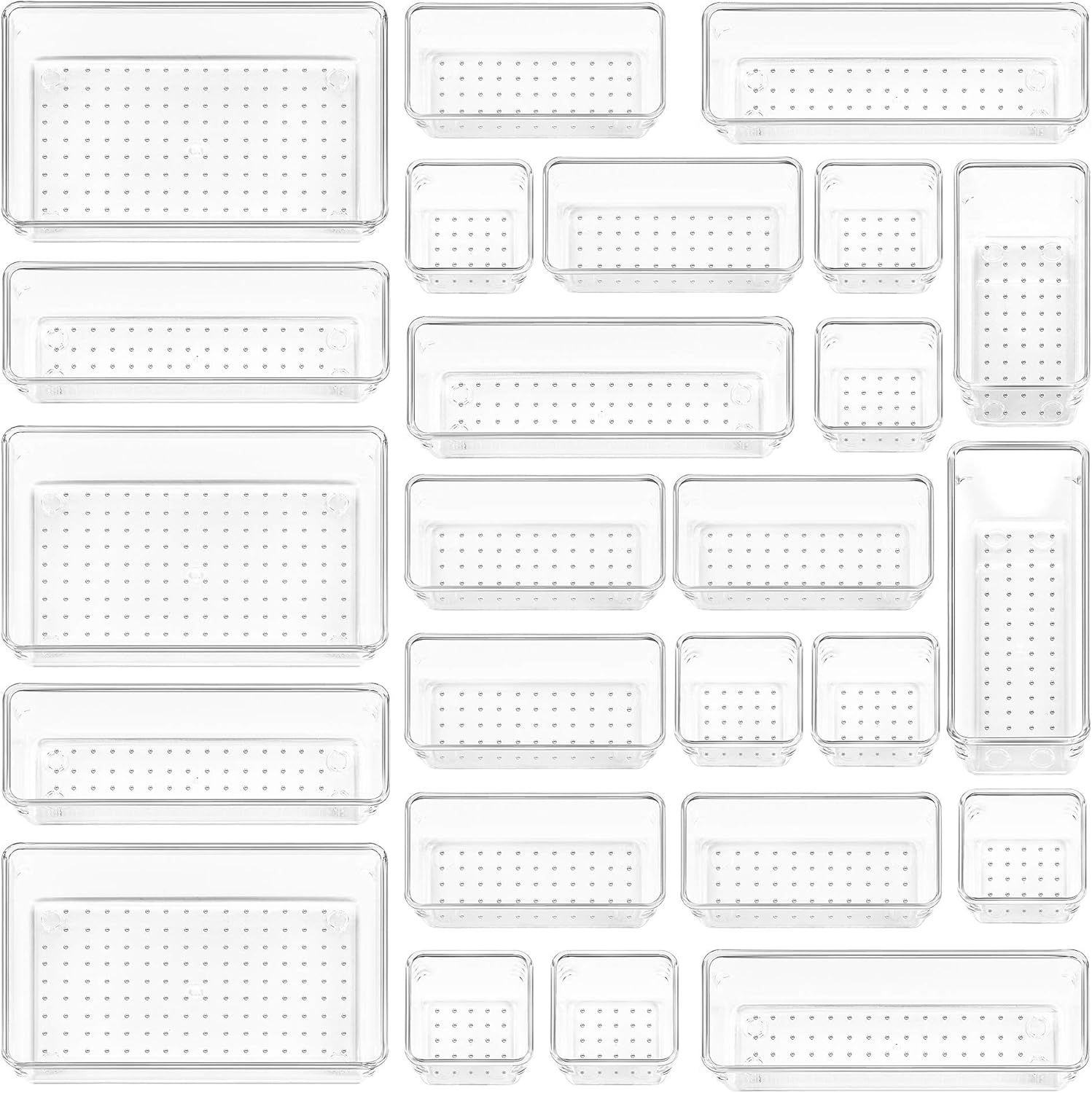
For these, think in layers. A set of clear plastic organizers on the bottom holds smaller items. A second tier — either a riser insert or a shallow bin placed on top — holds a second category. Clear Plastic Drawer Organizers (25-Piece Set) gives you enough pieces to build a layered system without overspending. Use the small bins for single-category items like measuring spoons, twist ties, or corn holders and stack accordingly.
Lid and Wrap Storage in Long, Narrow Drawers
A drawer that is long but narrow is the classic junk-magnet because nothing quite fits. This is actually the ideal drawer for vertical storage of things that are hard to store anywhere else: food container lids, plastic wrap and foil boxes, and cutting boards.
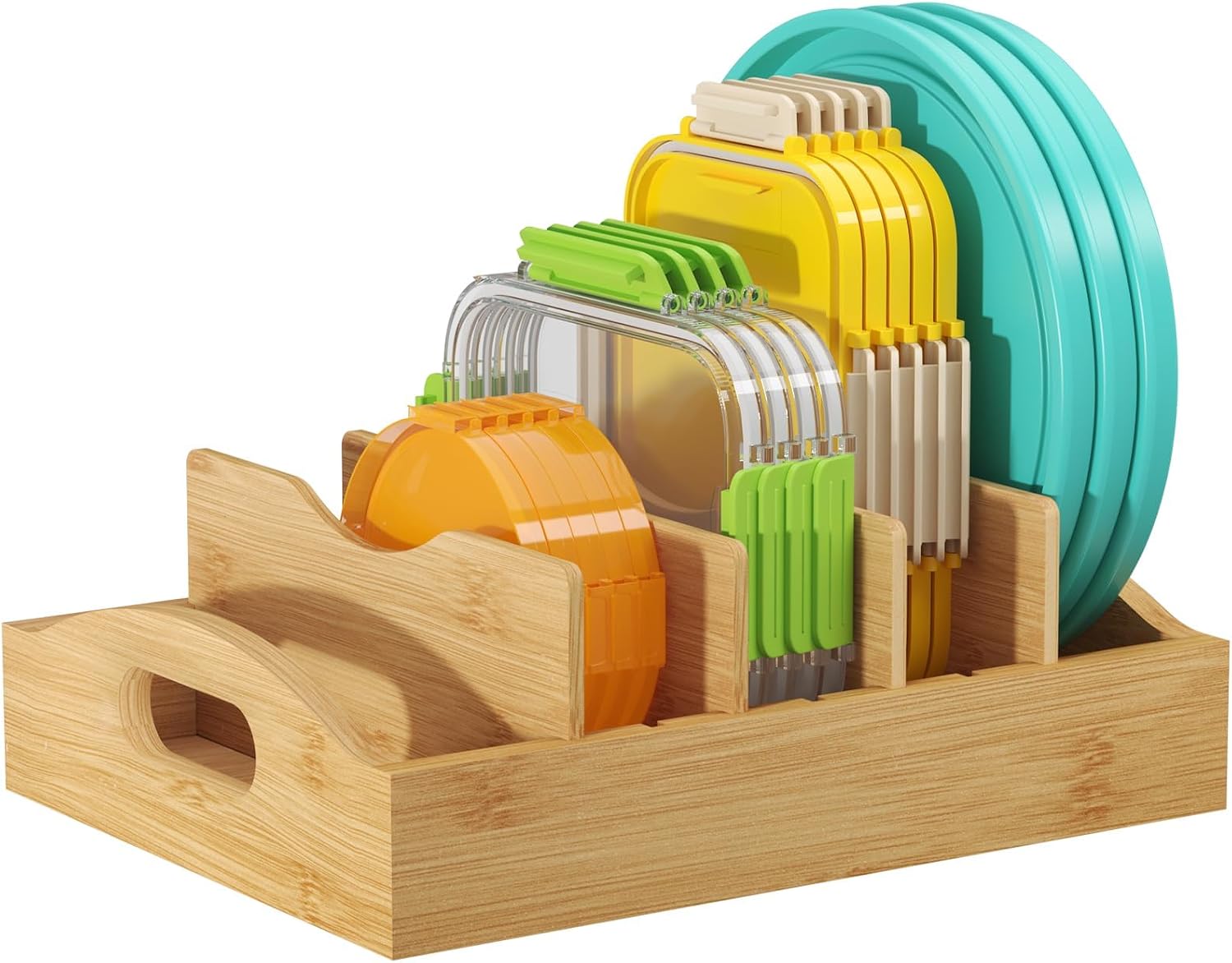
For container lids specifically, a vertical bamboo organizer holds them on edge the way a dish rack holds plates. Bamboo Food Container Lid Organizer is designed exactly for this and takes up far less space than a drawer full of lids stacked horizontally. For the wrap and foil boxes, stand them on their ends side by side. They stay put, you can read the labels, and you can grab what you need without pulling out everything else.
Keep It From Sliding Around
Even the best organizer fails if it migrates to the back of the drawer every time you open or close it. A thin non-slip liner cut to size solves this for almost every situation. Cut it to the exact dimensions of your drawer floor and lay it flat before placing any inserts on top.
For heavier items that tend to shift, a little bit of museum putty or a small piece of hook-and-loop fastener on the bottom of the insert does the job. It is a five-minute fix that makes a real difference. The goal is a drawer that looks the same when you open it on Tuesday as it did when you organized it on Saturday. That is not too much to ask.
The takeaway: Deep and awkward drawers are not a design flaw you have to live with. They are a layout problem, and layout problems have solutions. Measure first, divide into zones, choose inserts that actually fit your dimensions, and give everything a specific home. Once you do that, even the most chaotic drawer becomes something you are genuinely happy to open.
Everything mentioned in this guide

Bamboo Expandable Drawer Organizer
View product →
Bamboo Kitchen Drawer Dividers (4-Pack)
View product →
Utensil Drawer Organizer (5-Slot)

Silverware Drawer Organizer (9-Slot)
Clear Plastic Drawer Organizers (25-Piece Set)
View product →