How to Style Open Shelves So They Look Tidy, Not Cluttered
Last updated: 2026-09-22 · 4 min read
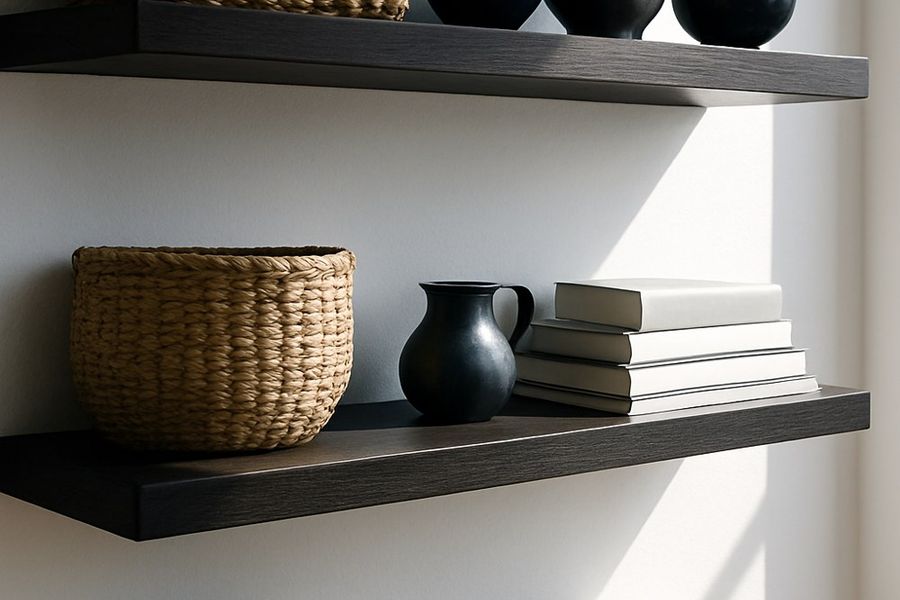
Open shelves are either a dream or a slow-moving disaster, and the difference usually comes down to a handful of decisions made before a single object is placed. I love open shelving because it forces you to be intentional. Every item is visible, which means every item has to earn its spot. If that sounds stressful, I promise it gets easier. Here is exactly how I approach it.
Start With a Hard Edit
Before you think about styling, take everything off the shelves. Every single thing. Put it on a table or the floor and ask two questions about each item: Is it something I actually use or genuinely love? And is it something I would be fine looking at every day?
Anything that fails either question goes in a drawer, a cabinet, or out of the room entirely. Open shelving is not extra storage. It is curated display. The edit is the hardest part, but nothing else works without it.
Group by Category and Visual Weight
Once you know what is staying, sort it into loose categories: books, ceramics, plants, baskets, practical items you reach for often. Then think about visual weight. Heavy, dark, or large objects anchor a shelf. Light, small, or delicate items need to be grouped together to register at all.
A general rule: place heavier or taller items at the ends or lower shelves, and lighter items toward the center or upper shelves. This keeps the whole unit from feeling top-heavy or lopsided. Odd numbers of objects in a cluster almost always look more natural than even numbers.
Use Containers to Tame the Practical Stuff
The biggest mistake people make on open shelves is displaying things that are inherently messy: loose batteries, random cords, a stack of takeout menus that somehow never leaves. The fix is not to hide all practical items. It is to contain them.
A basket holds throw blankets without looking like a pile. A jar holds pens without looking like a junk drawer. For shelves in a kitchen or office, Airtight Glass Storage Container or Glass Apothecary Storage Jars (6-Set) do the job beautifully and the contents become part of the display rather than a distraction from it. If you have a cord situation to deal with, Woven Cable Management Box (2-Pack) tucks it away cleanly.
Create Breathing Room
Crowding is what makes shelves look cluttered even when every individual item is nice. A good starting point is to leave roughly 20 to 30 percent of each shelf empty. That negative space is not wasted. It is what lets the eye rest and what makes the objects you have chosen look considered.
If you find yourself unable to leave anything empty, that is a sign the edit in step one was not aggressive enough. Go back and pull more.
Build in Repetition and Rhythm
Shelves that look intentional usually have some element that repeats: the same material, the same color family, the same type of vessel. Repetition creates rhythm, and rhythm reads as order even when things are not perfectly symmetrical.
This is where my fiance and I actually agree, which is saying something. They care deeply about how things feel; I care about how they are organized. Matching glass jars or a consistent wood tone satisfies both of us. A set like Glass Candy & Cookie Jars (4-Set) gives you that repetition instantly and looks far more deliberate than four random jars from four different places.
Layer Depth Intentionally
Most shelves are deeper than they look, and that depth is either an asset or a problem depending on how you use it. Place larger or taller items toward the back and smaller items in front. Let them overlap slightly rather than lining everything up in a single flat row. That layering adds dimension and makes the shelf look styled rather than stacked.
If your shelves are wall-mounted and you want to add a second surface or expand what you can display, Rustic Wood Floating Shelves (Set of 3) are a clean option that adds levels without taking up floor space.
Maintain It Like a System, Not a One-Time Project
The reason most open shelves slide back into chaos is that there is no habit attached to them. Build one simple rule: anything that does not have a spot on the shelf does not go on the shelf. When you bring something new in, something else comes off.
Once or twice a year, do the full edit again. Tastes change, clutter creeps in slowly, and a fresh eye catches things daily familiarity misses. I do a shelf reset every spring and again before the holidays. Takes about twenty minutes. Worth every second of it.
The takeaway: Styled open shelves are not about perfection. They are about intention: what you keep, how you group it, and how much space you leave around it. Get the edit right, use containers for anything inherently messy, and build in a simple maintenance habit. The result looks effortless because the thinking happened before anything went back on the shelf.
Everything mentioned in this guide

Glass Apothecary Storage Jars (6-Set)
View product →
Glass Candy & Cookie Jars (4-Set)
View product →
Airtight Glass Storage Container

Woven Cable Management Box (2-Pack)
View product →
Rustic Wood Floating Shelves (Set of 3)
View product →