How to Organize Tupperware and Food Containers for Good
Last updated: 2026-07-04 · 5 min read

You open the cabinet for a single container. Three lids fall out, something cylindrical rolls across the floor, and you end up crouched on the kitchen tile doing a puzzle you did not ask for. If this is your life, you are not alone, and you are not disorganized by nature. You just need a system that accounts for how containers actually behave, which is chaotically, unless you give them rules to follow. This guide will walk you through exactly how to build that system, from the purge to the final placement. No vague advice. Real steps.
Start With a Full Purge, No Exceptions
Pull every single container and lid out of the cabinet and put them on the counter or kitchen table. All of them. Yes, the ones from the back.
Now do the matching game. Every container needs a lid that fits. If you cannot find the match within 60 seconds, it goes in the donate or recycle pile. A lidless container is not a container. It is clutter with optimism.
While you are at it, check for staining, warping, or containers with lids that no longer seal flat. Anything that is structurally compromised goes. This step alone typically cuts most people's collection in half, which is the point.
Decide How Many You Actually Need
Before you put anything back, count what you have left and ask honestly: do I need this many? A good baseline for a two-person household is eight to twelve containers in a mix of sizes, small (1-2 cup), medium (3-4 cup), and large (6+ cup), plus a couple of rectangular ones for leftovers.
If your containers are a mismatched collection accumulated over a decade, this is a good moment to consider switching to a uniform set. Matching containers stack cleanly, take up less space, and their lids are interchangeable. Airtight Food Storage Containers (24-Pack) is a solid 24-piece airtight set that nests neatly and takes up a fraction of the drawer space that a random collection does.
Separate Lids From Containers Immediately
The number one reason Tupperware cabinets descend into chaos is storing lids on top of or inside containers with no structure. The lids migrate. They tip. They create an unstable tower that collapses the moment you touch one.
The fix is simple: give lids their own dedicated zone. A deep drawer is ideal. Use a bamboo drawer divider to create sections by lid size so small, medium, and large lids each have a lane. Bamboo Kitchen Drawer Dividers (4-Pack) works well here because the dividers are adjustable and hold their position without adhesive.
If you are working with a cabinet instead of a drawer, a narrow vertical file holder or a tension-rod divider on the cabinet shelf keeps lids upright and sorted. Vertical is the key word. Horizontal lid stacks are where systems go to die.
Stack Containers by Size, Nest When Possible
With lids handled separately, your containers can now nest inside each other by size without lids disrupting the stack. Group them: small inside small, medium inside medium, large inside large.
Store containers with the opening facing up so you can see the sizes at a glance. If a container cannot nest (some rounded shapes resist this), it gets its own spot at the back of the shelf rather than living sideways in the middle of everything.
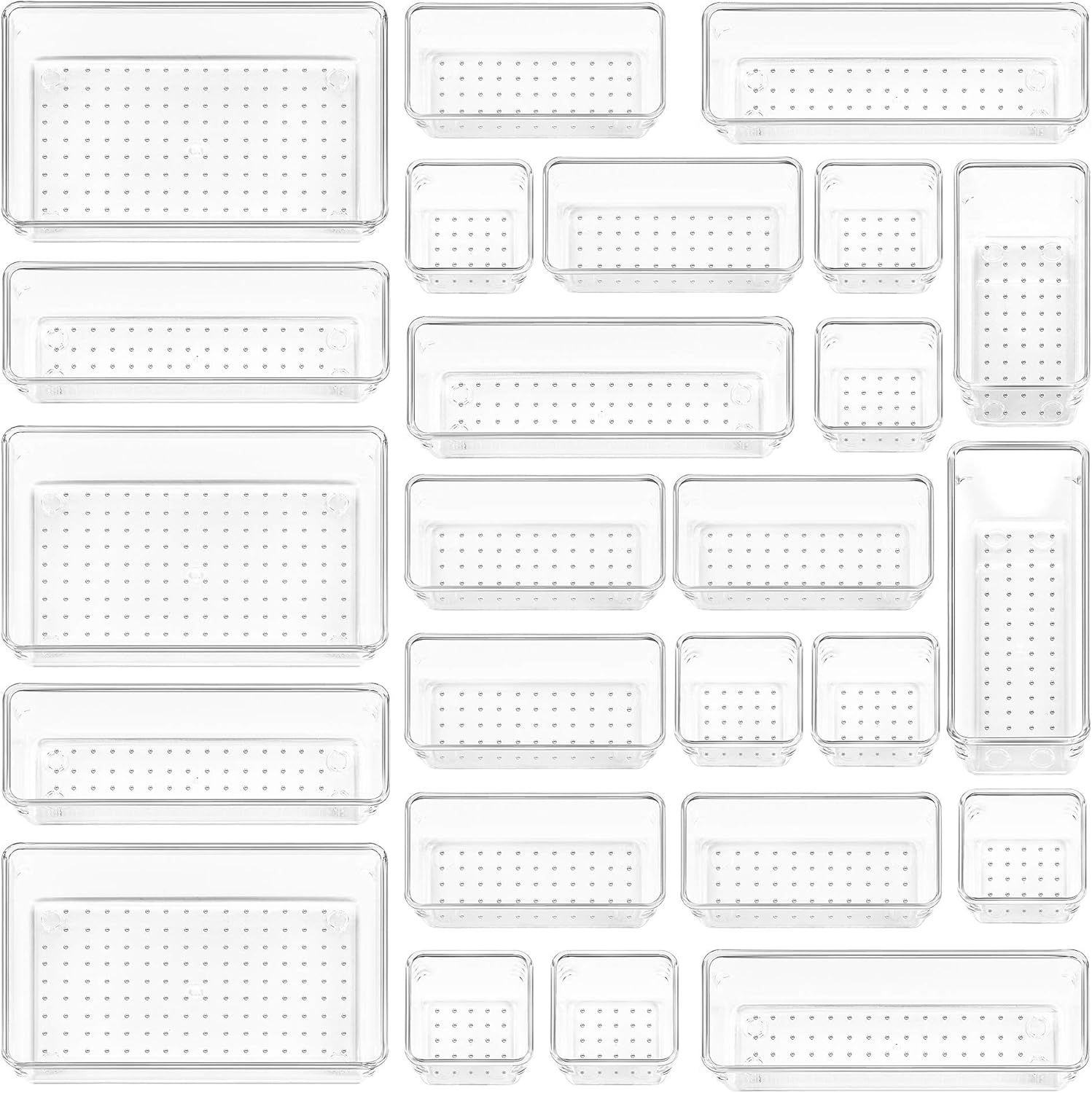
For deeper cabinets, a small stackable bin or a pull-out shelf insert helps enormously because you stop losing things behind other things. Clear Plastic Drawer Organizers (25-Piece Set) gives you clear compartments you can configure to fit your exact shelf depth.
Assign a Fixed Location and Protect It
Once everything has a place, label it. I realize that sounds like something only a very specific type of person does, and yes, I am that person, and the system has not failed me yet.
At minimum, decide that containers live on shelf two, lids live in the left drawer, and nothing else moves into those spots. The reason most systems fall apart is not the setup, it is the gradual creep of other items into the organized zone. Protect the location the same way you would a parking spot you paid for.
If you share a kitchen with someone who has a different relationship with putting things away, a quick label on the shelf edge or the drawer front removes all ambiguity. My fiance thought this was excessive until the system held for four months without a single rogue lid incident. Now it is a house rule.
Handle Specialty Containers Differently
Not every container belongs in the main stack. Large roasting pans with lids, glass meal-prep containers, and oversized stock pot lids are a different category and they need their own home.
Glass containers specifically do better stored with their lids on rather than separated, because they are heavier and less prone to the toppling problem. Keep them on a lower shelf or in a lower cabinet where they are stable and easy to grab.
For an overflow of meal-prep containers or specialty storage, the inside of a lower cabinet door is underused space. A slim over-the-door organizer can hold flat lids or lightweight rectangular containers without taking up any shelf real estate. Over-the-Door Hanging Organizer (5-Shelf) has five shelves and fits most standard cabinet doors with no drilling required.
Maintain the System in Under Two Minutes
A container organization system only works if putting things away is as easy as taking them out. If returning a container requires thought or effort, people will stop doing it, yourself included.
Every time you unload the dishwasher, do a 90-second reset. Containers go nested in their size group, lids go vertical in their lane, anything that has wandered gets returned. That is genuinely all the maintenance this requires.
If you find yourself doing a full re-sort every few weeks, it usually means one of two things: you have too many containers for the space, or the lid zone is not clearly defined enough. Both are fixable with another small purge or a slightly better divider.
The takeaway: Tupperware chaos is not a character flaw. It is an engineering problem, and it has a straightforward solution. Purge to only what you use, separate lids from containers, store each category in a fixed and labeled spot, and maintain it for 90 seconds every time the dishwasher runs. The cabinet will stay functional because the system asks almost nothing of you after the initial setup.